Showing posts with label classes. Show all posts

Wednesday, March 25, 2009

Bison Butchering Class

Warning: This blog entry contains vivid pictures and descriptions of a real bison being butchered. If the sight or thought of blood and guts makes you squeamish, skip to the last two pictures which show what a human carnivore is comfortable with seeing these days. If you want to see the whole story of where the bison meat came from, continue on.

On Saturday March 21st, my brother and I taught our first class for TrackersNW. We had 17 students participate in our Bison Butchering class. We started the day at 9am at the L-Bar-T Bison Ranch. My brother opened by reading the following quote from Steven Rinella's "American Buffalo - In Search of a Lost Icon".

How can someone suggest that paying for the slaughter of animals is more justifiable than taking the responsibility for one's food into one's own hands? At moments like this, though, I understand their perspective much better. It takes a strong stomach and a lot of dedication to do this job properly. You need to be able to visualize the end result - high-quality food - at a time when your sensory perceptions are seeing everything but that. Civilization is a mechanism that allows us to avoid the necessary but ugly aspects of life; most of us do not euthanize our own pets, we don't unplug the life support on our own ailing grandparents, we don't repair our own cars, and we don't process our own raw sewage. Instead, the delegation of our less-pleasant responsibilities is so widespread that taking these things on is almost like trying to swim upriver. It's easier not to do them, and those who insist on doing so are bound to look a little odd.


Each student had their own reasons for taking the class but I imagine that taking responsibility for one's food was a reason for many. For this reason and other personal ones, I volunteered to kill the bison as opposed to having the ranch owner do it. Bison are wild animals so the traditional bolt gun used for domestic cattle was not an option. I used a handgun as the ranch owner typically does. It was an emotional experience for sure.

The 1050 lb. bison bull before slaughter.


Once the bison was dead, his throat was cut for bleeding. The ranch owner and his son took care of hanging him using their front loader. This made the job of bleeding and skinning a lot easier because we had gravity to help.

The blood was collected by some students for fertilizer and other projects.


After bleeding the animal, the next step was to remove the head. Up until this point there hadn't been any student participation, but several volunteers eagerly stepped in to work on the head.

The removed head was then skinned while others worked on the body.


We did almost all the skinning using stone flakes and stone knives. The stone knives were very good at removing the skin.

Several students working on different parts of the hide.


Once we had the hide peeled back from the belly, we opened it up to remove the organs. This was one of the more challenging parts do to the amount of connective tissue that had to be broken up without sharp tools for fear of piercing organs. The last thing we wanted was digestive materials on the meat. It was quite an experience being shoulder deep inside feeling around for connective tissue. The body was still hot inside after an hour.

After removing the guts. The heart and lungs are still inside at this point.


We caught the guts in a plastic bin and took them aside to sort through. Clumps of fat were gathered for various projects. The liver and other organs were kept for a meat processing and preserving class the following day.

One of our instructors Shaun (bottom left), leads students in sorting through the gut pile.


The scene at the ranch.


The students finishing up the skinning.


The animal was split into six pieces plus the head. Four legs and the torso cut in two. We did the whole thing while keeping all the bones intact. I write this tonight after dropping the bone collection off at the Portland State University science lab where we will have the opportunity to assemble it into a museum style articulation. The professor we gave the bones to said that it would be put on display somewhere so hopefully that happens down the road.

Two front legs packaged up for transportation back to Portland.


At 3pm we all met back at the Scout Pit in Portland to cut up and package the meat. Fat and sinew were collected for future projects. Once the major hunks of meat were removed they were sliced up, packaged and labeled.

Students working on the six sections.


Here is but a small sample of the meat harvested.


After all the meat was packaged up, the students divided up all the meat that they worked so hard for.

At the end of the day we enjoyed the fruits ...err, meats of our labor.


Overall it was a great experience on many levels. I learned and experienced so much. The work didn't stop that day though. My next blog will explain some of what my brother and I did the following day.

We are tentatively planning to teach this class again in May.

Wednesday, November 08, 2006

The Sacred Hunt

The second class I took at PAST Skills was called The Sacred Hunt. Since I have no experience in hunting, everything taught was new to me. I learned a lot! The first two days we packed in a lot of lecture and shooting practice. The last three days we were mostly out hunting.

The rule was that we could only take a shot if the deer was within 5 yards. The reason for this is so that we are more likely to get a clean kill with minimal suffering for the animal. I think another reason is that from 5 yards you can know what you are killing before you kill it. I think you really have to be there for the right reason to go through with it once you see how beautiful and peaceful the animal is.

It is incredible the number of skills involved in hunting in this fashion. Imagine having to find a location in the woods where a deer will pass by you within 5 yards. Then imagine not being scented, seen, or heard as the deer gets that close. I forgot to mention that your mind also has to be clear because animals can sense your mood even before their other senses come into play. Also don't let any birds or squirrels know you're there either because they'll tell the deer. Then try to draw your bow without being seen or heard and make sure you hit the deer in the right spot. Hopefully the bow and arrows you made from scratch are of good quality. Finally, you better know how to follow a blood trail or your hard work is for not.

After this the work really begins. You have to honor the deer by using as much of it as you can. That means butchering the meat, boiling the bones and extracting the sinew for tools, tanning the hide, etc.

As Billy said hunting is the reason for practicing primitivie skills. You have to be able to track, use camouflage, build bows and arrows, flintknap arrow points, understand bird language, etc. to be successful at hunting.

So how did I do? First of all I didn't kill a deer. I didn't even take a shot. I did learn a ton of stuff each time I hunted though. For the record I did have two does broadside at 20 yards that never knew I was there. If I was hunting with a rifle it would have been an easy kill. I was content to see deer that close in a natural setting.

Long before the deer showed up, I determined through "inner vision" that I was going to see deer but not shoot any. At the time I thought that meant I would see a buck since we were only hunting does. I forgot that the other possibility was to see does that were out of my range. The last day we hunted I had the same vision and a doe came through my area again. This time it was actually right in my shooting lane, the only problem was that it was sprinting through it since it had seen me moments before.

That doe had been shot by another student minutes before. I like to think that it's hyper-aware state was part of the reason I got busted, but I know my cover and camo was pretty weak too. Later we followed the deer's blood trail for probably 600 yards before we lost it. It was determined that the deer was hit in the muscle of the leg and would probably survive. Even from 5 yards there is no guarantee of a kill. It was a tough way to end our class, but we learned many lessons.

I didn't end up taking many pictures since I was out hunting a lot of the time. Here is a picture from a 3d shooting course. This helped us practice shooting through brush at life-like targets.


For fun we took shots at a bear target off in the distance. I estimate the distance at about 60 yards. One of the times we shot, I was 2 for 2. One shot hit the bear in the eye. I was pretty lucky but I felt cool. No one else hit it.

Tuesday, November 07, 2006

Flintknapping Workshop

I'm back from my trip. I took two classes at PAST Skills wilderness school. This is a new school founded by Billy and Kristy McConnell who used to be instructors at the Tracker School where I have taken most of my other classes. There are many attractive things about this school. The staff are awesome people and practitioners of primitive skills. The class sizes are small so you get a lot of personal attention. The atmosphere is very laid back. While not learning we all hung out at the house we stayed in. The food we ate was amazing. Among other things we had fresh duck and caribou. The meal of duck was basically like a traditional Thanksgiving dinner.

The first class was a four day flintknapping workshop. I learned way more than I expected. The class size was key. I had a front row seat to watch Billy break rock. One can learn a lot just from watching someone better especially that close. Each of us also got a personal session which was huge for me. Billy corrected my form which is going to have a major effect on my progress.

Here is Billy demonstrating. You can see that the piece is taking shape. He started from a big chuck like the one on the floor at the bottom right of the picture.


Another big help was the amount and type of rock available. Rock can get quite expensive not to mention hard to come by so it was great to have a huge supply of rock. I was never worried about wasting money with each strike I took like I was at home with my $25 dollar rock.

While not in lecture, we spent most of our time actually practicing. This picture shows our "knapping pit". In this picture everyone is pressure flaking on small pieces as opposed to striking them like in the first picture. Pressure flaking is used on smaller pieces for shaping, sharpening and notching.


I spent a lot of my time doing billet work since I had done a decent amount of pressure flaking before taking the class. I had almost zero experience in billet work going into this class so I chose to focus on it. Here are some of the pieces I worked on. The only one that is nearly finished is the gray piece at the bottom right. The gray rock is Dacite and the rest are Obsidian. The larger obsidian pieces on the sides are preforms that can further be reduced to become sharp points. These started as big chunks of rock. You can see I snapped one piece in half. I'm going to try to make an arrow head out of the top piece.


Another cool thing we got to learn about is cooking rocks. Some rocks are hard to work with naturally, but can be cooked to make them workable. We cooked rocks both primitively with a fire and in a kiln.

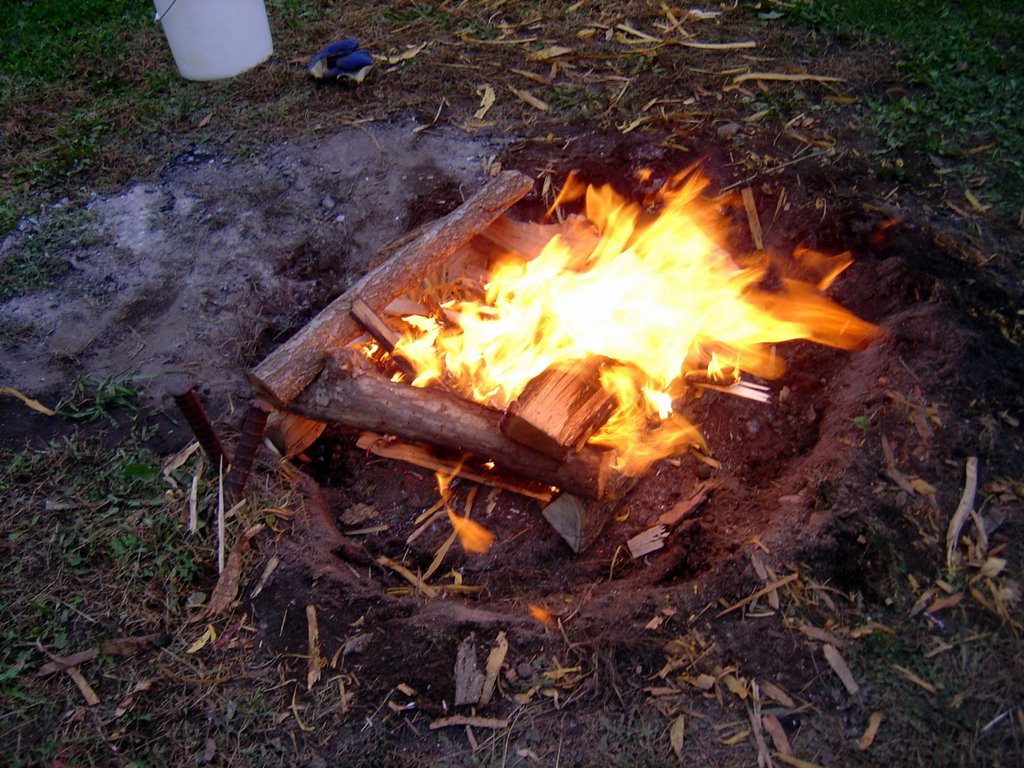
Here is rock called Ft. Hood Chert. We covered it up with about 2 inches of dirt and then built a fire over it.


The fire burned over night. When it was done we had usable rock. It was very fun to work with. It is very different from obsidian. You actually have to strike the rock hard to get it to fracture. With obsidian it is like lightly peeling off flakes of rock.


I didn't really complete any pieces at the class since I was focused on billet work, but I'll probably try to make some before the weather gets too cold. We got to split up all the cooked rock as well as a bunch of other pieces. I also bought some rock so now I now have plenty of rock to work with. I'll post pictures of any new points I make.

My next post will be about the second class I took which was a hunting class.

Wednesday, July 05, 2006

Urban Scout Class

Last week I attended the Urban Scout class at the Tracker School. Going into it I wasn't sure what to expect. The class had never been taught before and I didn't know how an urban scout class would be taught in the Pine Barrens. I was pleasantly surprised with how things went.

First, we didn't repeat any of the stuff I learned in the first Scout class. We basically picked up right where we left off. At the Scout class we spent a ton of time learning how a scout team works and practicing maneuvers. This time all we did was practice as a team for a couple hours to get to know each other and to refresh ourselves on the basics. We didn't have to worry about other scouts laying traps for us. We didn't have to live in scout pits and keep someone on watch all night. It was more relaxed.

We did some interesting exercises to practice moving without causing movement or sound. One night we had an obstacle course set up around camp. Each station had a person by it who was there to detect sound and/or movement. Our goal was to get over/through/under the obstacle without causing alarm.

Here is one of the obstacles. It is a wood pile covered by a tarp. The tarp made it a lot harder because of the extra noise it makes and because it blinds you to the instability of the wood underneath.


Another obstacle was to get into and back out of the back of a vehicle without the driver and/or passenger noticing. This meant you had to be low enough to not be seen in the rear view mirror and you had to get in and out slowly enough so the people couldn't feel the vehicle sinking/rising.


These and the other obstacles were a really good workout. The amount of energy it took to control my body for extended periods of time was astounding. It was especially hard when I had to exert myself and then control my breathing so it wouldn't be heard.

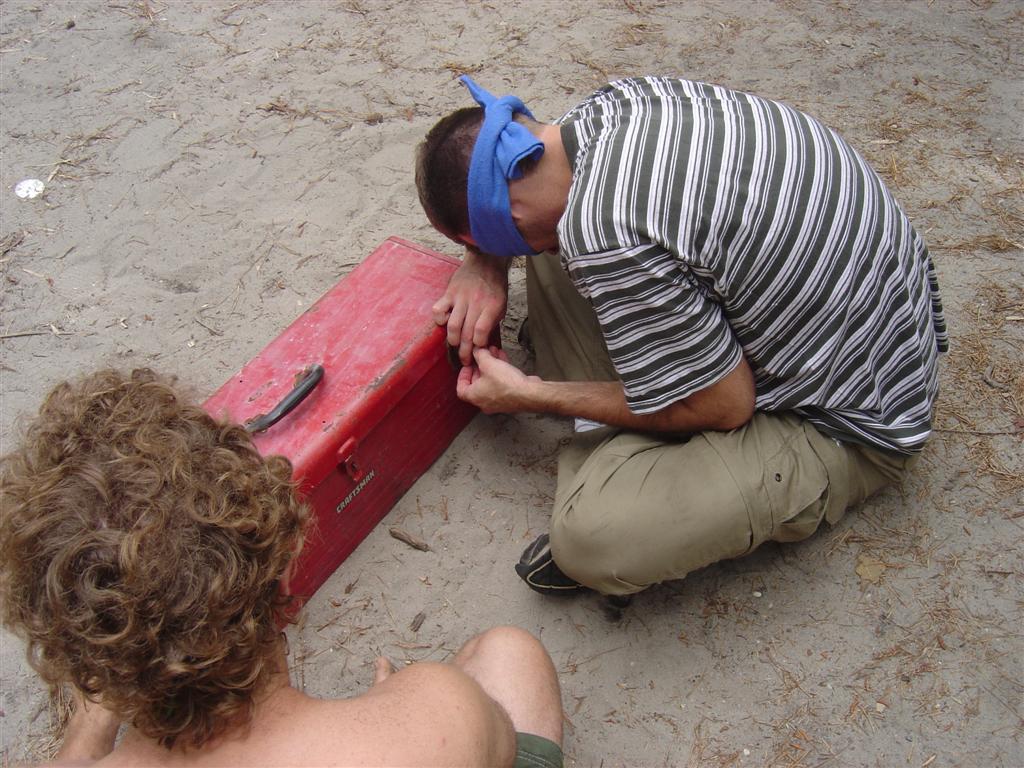
Another exercise we did was to open a toolbox and remove everything inside without making any noise. To make things more difficult we were blindfolded and couldn't talk to our partner. This box had an 8 ft rusty chain inside which made it difficult. The exercise gave me the feeling I was disarming a bomb.


We also learned some interesting uses of rope in a combat situation. We were taught a cool knot for making handcuffs. Hopefully I'll never have to use that knot.


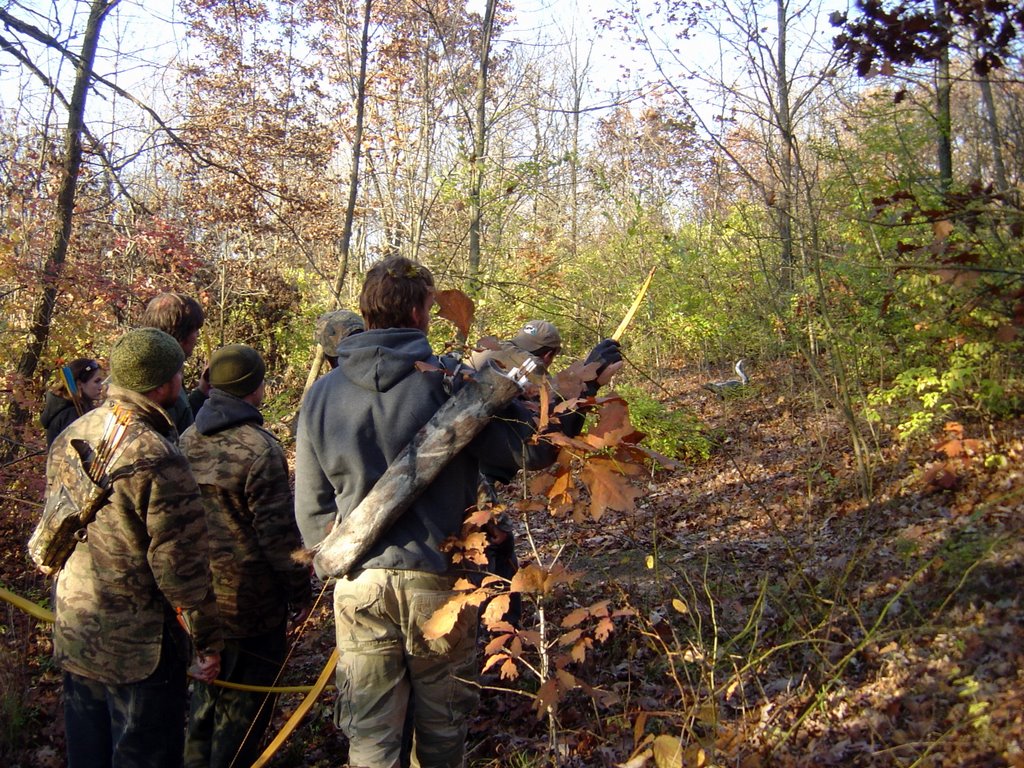
The night that I arrived I was very happy to find out that we would in fact be going on some urban missions. Our first mission out of camp was to go into a nearby park and recon the buildings inside. The added risk was that there was a security guard that patrolled the park and police officers were known to drive by. What made it more risky was that we were not allowed to use primitive camouflage. As you can see in this picture, with primitive camouflage on you can become almost invisible day or night.

It was fun exploring the park having to stick to the shadows. In the woods, there is so much cover that you can get to if someone is coming. In the urban environment you've got some shrubs, trees, benches, and the shadows they cast. That's about it. There are also motion sensor floodlights, mirrors and video cameras to contend with. Obviously there are a lot more people around too which makes it all very difficult.

The two other nights we went out were to a Boy Scout camp down the road. One night there were boy scouts actually in the camp. Little did they know that there were about 60 scouts in amongst them. I didn't actually get into too much action when the boy scouts were around, but the other night was fun. At one point my buddy and I were crawling along the grass next to a parking lot on the right. We were right under a street light so there was no shadow. The ground was slanted so we couldn't be seen from the left. I whispered to him, "as long as no one comes from the right we should be ok." About 10 seconds later, car lights come on ahead of us. Luckily there was one car still in the lot blocking the car from seeing us. My friend ran in a crouch up to the car for cover and I slinked into the shadow the headlights cast on the pole of the street light. The car drove right by us without stopping. It was pretty exciting. I had to just trust that a normal unaware person would not notice me in the shadow.

Here is my team before our first mission.


To close, I have a funny story to tell. Today at work I was headed to the break room. To make my day more interesting, I was practicing walking quietly kind of pretending I was on a scout mission. So I opened and closed the doors to the stairwell without making noise. I used a technique for looking around a corner and seeing someone before he sees you. Since I wasn't being too serious I did it way too fast to be affective. So who was around the corner? None other than the CEO of the company. He totally caught me peeking around the corner. He said something like, "What are you doing there peeking around the corner, Pinger? Are you trying to be a spy or James Bond or something?" As we walked by each other he went on and on about it and I just laughed and said something stupid like, "I'm just making sure I'm not going to get jumped." That was the only time I've ever been caught doing something like that and it had to be the damn CEO that caught me. :)

Wednesday, February 01, 2006

Urban Scout Class: Sign me up!

Today I received a wonderous phone call! I was informed that I was enrolled in the Urban Scout Class in June. For those who don't know, last summer I went to the Scout class at the Tracker School. A link to the school web page is on my main page. Here is the class description:

This course recreates the Apache Scout experience and gives participants an opportunity to live as the Scout did, travelling away from his tribe, with few tools and equipment, gathering information from tracks and sign, and hiding from his enemies. This is a true high adventure experience that teaches participants to survive and observe as did the Apache Scout - the greatest survivalist of all.

Here is a picture of my group camoed up before a raid. I'm bottom right and my brother is bottom left. It was one of the greatest classes I've been to.

What makes the Urban Scout so special is that this summer is the first time they're doing the class. That means that I could be in a class with people that have been through the advanced and expert levels which are invite only. It's also likely that this class won't be held again for a few years and possibly never. Of course the topic also makes it special and hopefully more applicable to everyday life. Here's the class description:

The Urban Scout course is intended to cover the application of the traditional Scout skills, techniques, principles and teachings toward our modern day lifestyles. We will work (play) with in the variations of information gathering, teamwork and invisibility applied to the everyday modern world.

The bottom line is you don't get many chances in life to spend a week with a group of people going on raids and missions. I can't wait till June.